Some time ago, a customer with both 5‑axis gantry machines and more than a dozen standard 3‑axis vertical machining centers approached us with a question:
“Can we standardize on one single type of probe? The radio‑frequency probes are admittedly more expensive, but we want a one‑and‑done solution.”
The initial knee‑jerk reaction to this thinking — “if it is expensive, it must be better” — is precisely where missteps begin.
I. Problem Definition and Scope Definition
The selection of machine‑tool probes is essentially an engineering trade‑off between signal penetration and probe interchangeability. Once this decision is made, subsequent machine retrofitting, probe deployment and frequency resource management will be continuously impacted.
If you are facing any of the following pain points:
‑ Probe signal dropout occurs whenever the 5‑axis machining spindle tilts
‑ Concerns about signal crosstalk when deploying RF probes across dozens of machine tools
‑ Reluctance to drill holes for retrofitting high‑end machines, while optical solutions require internal cable routing
‑ Workshop probes need flexible redeployment among different machine tools
If your workshop only has one or two standard 3‑axis vertical machining centers and probes are dedicated to individual machines, the analysis below will be of limited relevance to you; an optical probe will suffice.
II. Root‑Cause Analysis: Trading One Capability for Another
The fundamental difference between the two technologies lies not in which one is more advanced, but in their signal transmission methods — and the chain‑reaction consequences that follow.
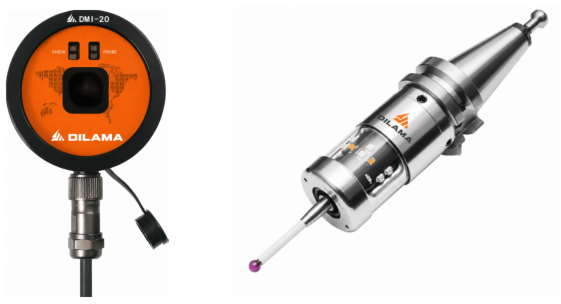
Optical probes work with infrared light, following the same principle as TV remote controls. As infrared is light, it cannot function with obstructions in its path.
Under ideal conditions, transmission distance is around 5 meters. In real‑world workshop conditions (oil mist, dust, minor obstructions), the effective range generally falls between 3‑5 meters. Obstructions from workpieces and fixtures, or a change in probe orientation after spindle tilting, will cause signal cut‑off. This physical limitation makes optical probes unsuitable for 5‑axis tilting‑spindle machining and deep‑cavity measurement.
Yet it has an often‑overlooked advantage: infrared light cannot penetrate machine sheet‑metal panels. When the receiver is mounted inside the machine, signals are naturally confined within that individual machine, with zero crosstalk to adjacent equipment. This means optical probes require no frequency pairing and support hot‑swap use across different machine tools.
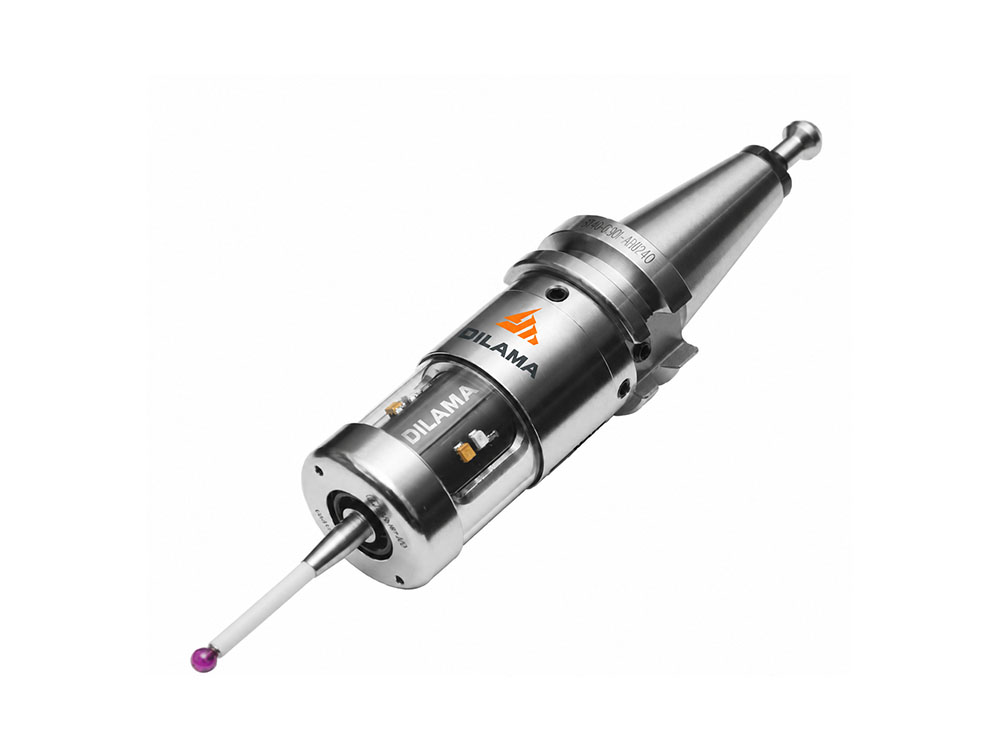
Radio probes adopt radio signals, similar to Wi‑Fi, capable of penetrating solid barriers.
Signals pass through workpieces, fixtures and machine housings, achieving transmission distances over 10 meters. Receivers are externally mounted; no drilling or internal cabling on the machine is required — a critical benefit for high‑end machine tools.
Nevertheless, barrier‑penetration is a double‑edged sword: signals may leak over to neighbouring machines. For this reason, RF probes require frequency isolation. Each probe‑receiver pair is assigned a dedicated channel, with more than one hundred distinct frequencies commercially available in the industry.
III. Decision‑Making Framework and Scenario Matching
Probe selection can be driven by two core questions: Does your machine require barrier‑penetrating signal capability? How many machine tools do you have in total?
Question 1: Does your machine need barrier‑penetrating signals?
|
Machine Tool Type and Operating Conditions |
What should you choose? |
Why |
|
5‑axis machining centers (tilting spindle /tilting rotary table) |
Radio |
The infrared optical path is inevitably obstructed after tilting, rendering optical probes physically unfeasible. |
|
Large gantry machines, horizontal machining centers, deep‑cavity workpieces |
Radio |
Workpiece obstruction + travel exceeds the effective infrared range |
|
High‑end machine tools, in‑production equipment, customer rejects internal retrofitting |
Radio |
External‑mounted receiver requires zero modifications to the machine; optical receivers must be internally secured with cabling routing. |
|
Standard 3‑axis vertical machining centers (VMC) |
Optical |
Open‑layout machining zone with no obstructions, providing an unobstructed signal path. |
|
Drill‑tap machines, high‑speed engraving‑milling machines, CNC lathes |
Optical |
Short travel and compact structure; infrared range is fully sufficient. |
Question 2: Are there many machine tools?
|
Workshop scale |
What should you choose? |
Why |
|
≤10 units, dominated by large high‑end equipment |
Radio |
Sufficient channel resources, low demand for probe interchangeability |
|
10‑50 units, mainly consisting of 3‑axis vertical machining centers |
Optical |
Optical probes require no frequency pairing and support hot‑swap deployment. This advantage becomes more prominent as the number of machines increases. |
|
>50 units or frequent cross‑machine redeployment of probes |
Optical |
At scale, the upper limit of RF channels together with frequent battery replacement becomes an operational burden. |
|
Mixed‑machine fleet |
Coexistence of two types |
Equip 5‑axis and gantry machines with RF probes, and the rest with optical probes. Different machine tools operate under distinct constraints; standardized single‑type deployment is unnecessary. |
Decision sequence: First identify machine tools where infrared signals will inevitably be obstructed — these can only be fitted with RF probes. Then check the quantity of the remaining machines. For large quantities, prioritize optical probes. Coexistence of the two types of probes is normal; one size fits all deployment should be avoided.
IV. Key Conclusions and Recommendations for Action
Two core judgements:
1. Neither optical nor RF probes is meant to replace the other. Optical probes trade off barrier‑penetration capability for unrestricted interchangeability and longer battery life. RF probes trade off channel‑binding and higher maintenance frequency for unconstrained signal penetration through barriers.
2. For 5‑axis machines, gantry machines and deep‑cavity applications, there is no need for hesitation: RF probes are the only viable option. Infrared technology is physically unfeasible in these scenarios — this is not a matter of performance preference.
Every workshop has unique conditions. If your application falls between typical scenarios and you find it hard to decide, feel free to contact us. Discussions will help clarify your workshop’s real‑world requirements.