3D Scanning and Modeling Case Study for Motorcycle Engine Housing
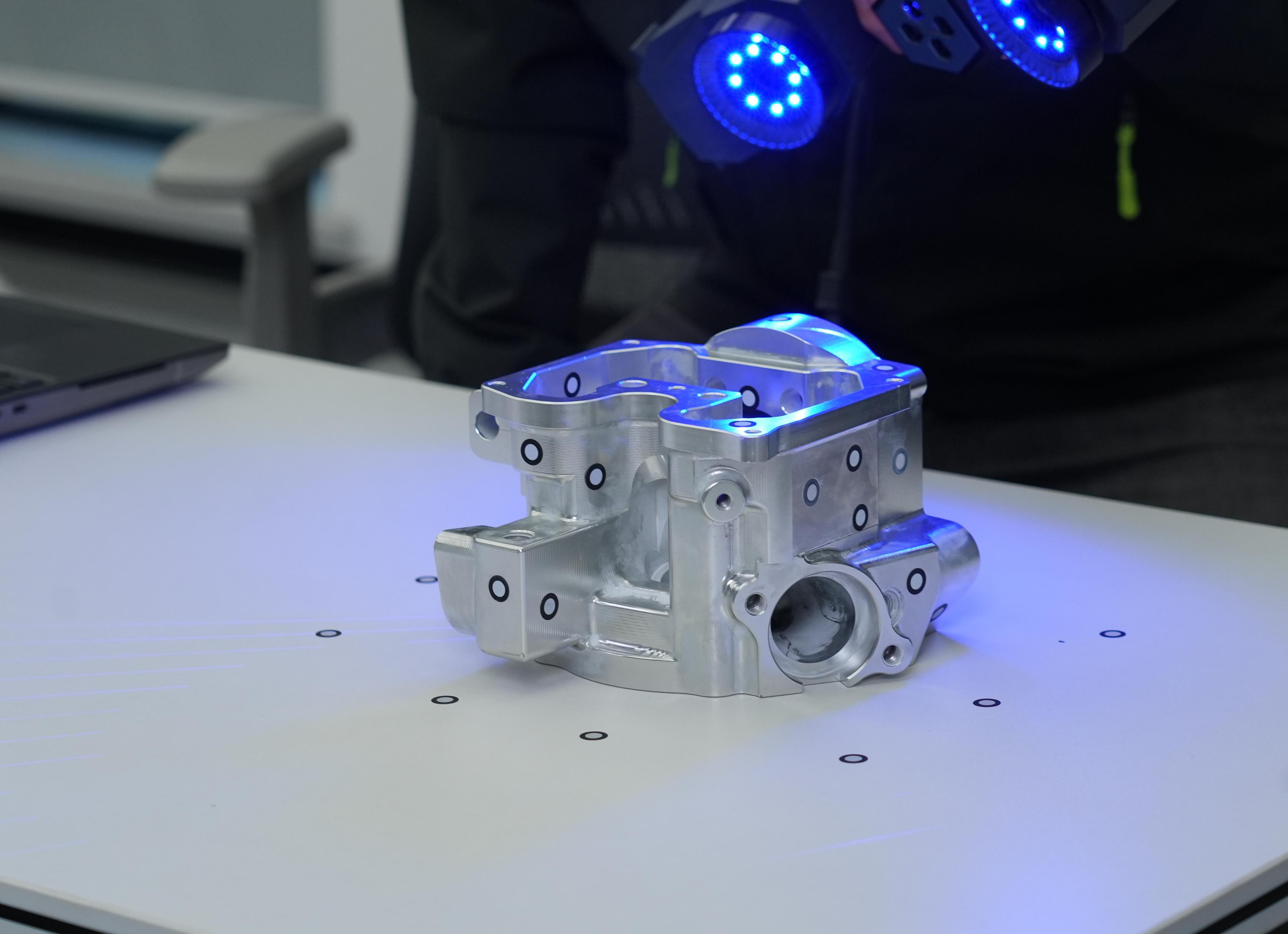
This case focuses on the 3D scanning and modeling of an aluminum motorcycle engine housing. As a core protective component of the motorcycle engine, the workpiece features a complex structure, smooth curved surfaces, and numerous deep holes, grooves, and other hard-to-scan areas. Made of high-gloss aluminum, the material is prone to reflective interference, requiring professional techniques to accurately capture 3D data and provide core support for subsequent reverse engineering and quality inspection.
Key Pre-Scanning Preparation
The engine housing is placed steadily on a shockproof workbench. A critical step is the application of special marking points to solve problems such as workpiece reflection and insufficient geometric features, ensuring positioning and stitching accuracy. Concurrently, the workpiece is cleaned, and scanning equipment is connected and debugged to guarantee a stable scanning foundation.
Core Scanning Challenges and Solutions
Deep holes, characterized by great depth and easy occlusion, represent a major scanning challenge. We adopt a multi-angle and multi-pass scanning strategy, optimize scanning resolution, and fill data blind spots through data overlay to precisely capture the internal features of deep holes. The entire process follows the principle of "whole first, details later", with operators monitoring and adjusting in real time to ensure complete scanning and accurate data.
Key Post-Scanning Procedures
Upon completion of scanning, priority is given to point cloud model optimization, including noise removal and detail supplementation. The core step is to conduct a comprehensive comparison between the model and the physical workpiece, verify key parameters, correct deviations, and finally generate a 3D model highly consistent with the actual part.
Core Value of This Case
This project efficiently overcomes the pain points of scanning complex workpieces and avoids the drawbacks of traditional measurement methods. It fully demonstrates the core advantages of 3D scanning technology in the digital acquisition of industrial workpieces, providing reliable support for subsequent related operations.