A Russian enterprise engaged in aviation heavy machinery processing has been deeply engaged in the aerospace and engineering machinery fields, focusing on the mass production of key aero-engine forgings, fuselage structural castings and core components of heavy engineering machinery. Its products are widely used in Russia's high-end equipment manufacturing projects. As a core supplier in the aviation manufacturing industrial chain, the forged steel and cast iron workpieces produced by the enterprise generally have the characteristics of large size (single weight up to several tons), complex structure and inhomogeneous structure, and must meet the Russian National Standards.
I. Core Pain Points of the Original Detection Mode
1. Severe inefficiency, failing to adapt to the rhythm of mass production: The manual operation requires the entire process of "manual focusing → manual indenter replacement → manual loading → visual observation of indentation → manual measurement of indentation diameter in the micrometer eyepiece → calculation of hardness value". A single detection takes more than 2 minutes. For mass production needs, the detection link has become a production capacity bottleneck, often leading to delivery delays.
2. Poor data stability and prominent quality control risks: Manual measurement relies on the operator's experience, leading to frequent problems such as indentation positioning deviation and visual reading errors. The data repeatability error exceeds ±5%, and it is impossible to effectively cover the inhomogeneous structure areas of forgings and castings (large indentations need to cover more material areas to ensure data representativeness);
3. Lack of traceability system: Detection data relies on paper records and cannot be associated with all elements of "man, machine, material, method, environment and measurement". When quality disputes arise, it is impossible to quickly locate the root cause of the problem.
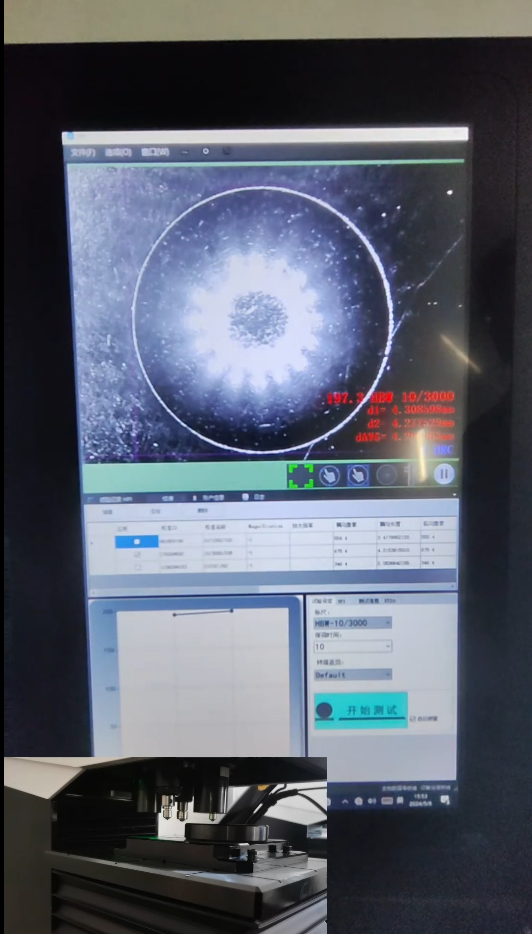
The DILAMA 6-Station Fully Automatic Brinell Hardness Tester is equipped with a 6-station linked automatic turret, featuring automatic positioning, automatic loading, and automatic focusing for indentation measurement, with no manual intervention required throughout the entire process. The detection efficiency is increased by 300%, and the test data repeatability stably complies with the specified standards. Laser positioning and AI visual recognition greatly reduce human errors, making it suitable for rapid random inspection of large rough workpieces such as forged steel and cast iron. It supports a Russian-English bilingual interface, automatic data storage, unqualified workpiece alarm and standard report output, perfectly meeting the quality traceability requirements for local applications in Russia and EU exports. Up to now, the equipment has been operating stably, helping users improve production capacity and strictly control product quality, and has become a cost-effective and highly reliable automatic hardness testing solution for Russian machining workshops.